

Artificial intelligence has created one of the biggest technology investment cycles in modern history.
Over the past few years, the spotlight has fallen on AI models, cloud platforms and the companies building the software that is transforming industries. Yet beneath this wave of innovation lies another competition—one that could prove just as important over the next decade.
It is the race to build the hardware capable of sustaining AI’s future.
As artificial intelligence becomes more powerful, the computing infrastructure supporting it faces mounting pressure. Larger models demand more processing power, consume more electricity and require increasingly sophisticated data centres. The question is no longer simply how to build better AI. It is how to build computers capable of keeping pace with AI’s growing ambitions.
That is where LongServing Technology believes the next opportunity lies.
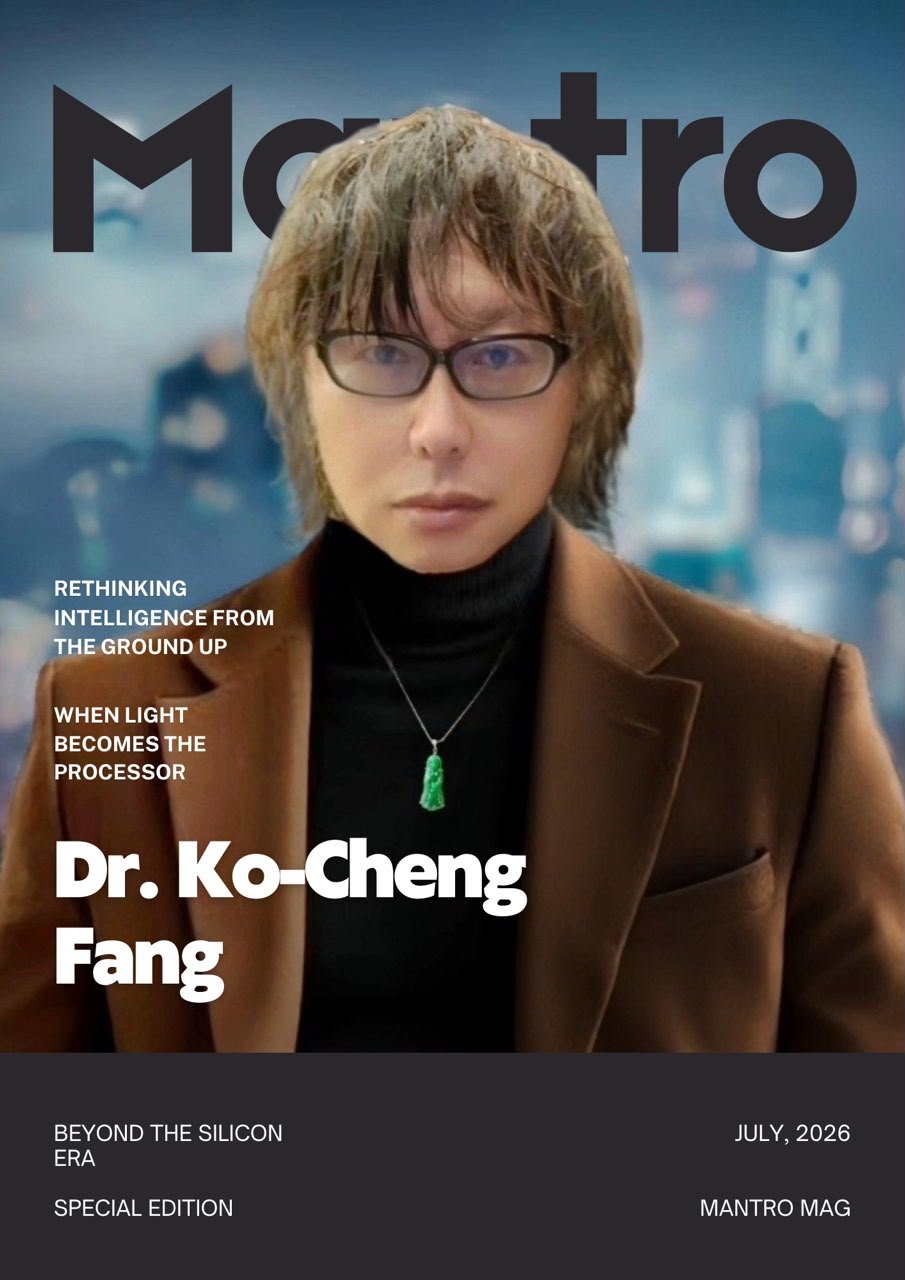
Founded by Dr. Ko-Cheng Fang, the Taiwan-based deep technology company is pursuing an ambitious vision: replacing conventional electronic computing with photonic computing, where light—not electricity—becomes the primary medium for processing information.
At the centre of that strategy is the company’s proprietary optical technology, X-Photon.
Dr. Ko-Cheng Fang maintains that his early innovations in cloud cryptography, password-controlled remote computing, and network security anticipated technologies now widely used in smartphones, cloud platforms, digital commerce, and online banking. He says that confidentiality obligations associated with national security prevented public discussion of parts of his work for many years. Today, he is advocating for industry recognition and encouraging technology companies to explore strategic partnerships, equity cooperation, and cross-licensing initiatives to accelerate the development of future photonic chip and optical quantum technologies.
A Different Bet on the Future of Computing
Most companies in the AI ecosystem are competing to develop faster models or more capable applications.
LongServing Technology is taking a different approach.
Rather than focusing on software, it is investing in the physical infrastructure that could support the next generation of AI systems.
The company’s research is built around a simple premise.
If future AI models continue to expand at their current pace, today’s semiconductor technologies may eventually struggle to deliver the performance and energy efficiency required for large-scale deployment.
Instead of asking how silicon can be improved incrementally, LongServing is exploring whether an entirely different computing architecture can address those challenges.
Why Light Could Change the Economics of AI

Photonic computing has attracted increasing interest because of its potential to transform how information moves through computers.
Conventional processors rely on electrical signals travelling through silicon circuits. LongServing’s approach replaces those electrical signals with photons.
In principle, this offers significant advantages.
Light travels faster than electrons and generates considerably less heat, characteristics that could enable future computing platforms to process larger workloads while consuming less energy.
For organisations investing heavily in AI infrastructure, these are not simply technical improvements.
They have direct implications for operational cost, scalability and sustainability.
As AI data centres continue to expand worldwide, improvements in computational efficiency are becoming increasingly valuable.
X-Photon: Solving a Practical Challenge
The promise of photonic computing has been recognised for years.
Commercial implementation has been considerably more difficult.
One of the biggest obstacles has been controlling light inside microscopic computer circuits.
Unlike electrical current, which can be directed through intricate pathways, light naturally travels in straight lines. This has limited the complexity of photonic processors.
LongServing Technology says X-Photon has been developed specifically to address that challenge.
According to the company, the proprietary material enables photons to travel through nanoscale optical channels while making controlled 90-degree directional changes within the circuit.
Although highly specialised, this capability addresses one of the engineering problems that has slowed the commercial development of photonic computing.
If successfully scaled, technologies such as X-Photon could become an important component of future AI hardware.
Building an Ecosystem Rather Than a Product
What distinguishes LongServing Technology is the scope of its ambitions.
The company is not positioning X-Photon as a standalone innovation.
Its roadmap extends to photonic quantum chips, optical memory technologies and Photonic Cloud Computing Centres designed to support increasingly demanding AI workloads.
This reflects a long-term platform strategy.
History suggests that transformative computing companies rarely succeed because of one breakthrough alone. Silicon became the foundation of modern computing because it was supported by manufacturing capability, software ecosystems, global supply chains and continuous innovation.
LongServing appears to be pursuing a similar philosophy—developing complementary technologies that together could support a broader photonic computing ecosystem.
From Research to Commercial Execution
Scientific innovation is only the first stage of building a new technology platform.
Commercial success depends equally on manufacturing, financing and strategic partnerships.
To support its next phase of development, LongServing Technology recently announced a US$500 million strategic financing initiative, based on a stated valuation of US$2.5 billion.
According to the company, the investment will accelerate photonic manufacturing, expand research capabilities and support the commercial deployment of its technologies.
The company has also outlined a framework for future strategic partnerships as it seeks to position photonic computing within the broader AI infrastructure landscape.
These initiatives suggest that LongServing is preparing not only to develop new technologies but also to build the industrial foundations required to bring them to market.
The Long View

Replacing an established technology is never straightforward.
Silicon remains one of the most successful engineering platforms ever created, supported by decades of research, mature manufacturing processes and an extensive global ecosystem.
Photonic computing still faces significant scientific, engineering and commercial challenges before it can achieve widespread adoption.
Yet major technology transitions often begin long before they become obvious to the market.
Artificial intelligence has already changed the software industry. The next phase of innovation may depend on rethinking the hardware that powers it.
LongServing Technology’s work reflects that broader shift.
Whether X-Photon ultimately becomes a defining technology or one of many contributions to the future of computing, the company’s strategy highlights an increasingly important reality: as AI continues to evolve, competitive advantage will depend not only on better algorithms, but also on the infrastructure capable of supporting them.
For LongServing Technology, the opportunity is not simply to improve existing computers.
It is to help shape what comes after them.
Contact Information
Dr. Ko-Cheng Fang
Founder, CEO & Chairman
LongServing Technology Co., Ltd.
Email: service@longserving.com.tw
Website: https://longserving.com.tw/en/
Instagram: @ko_cheng_fang